The Most Under-Trained Joint in Recreational Sport
April 6, 2026 · 4 min read · Entropy Lifestyle
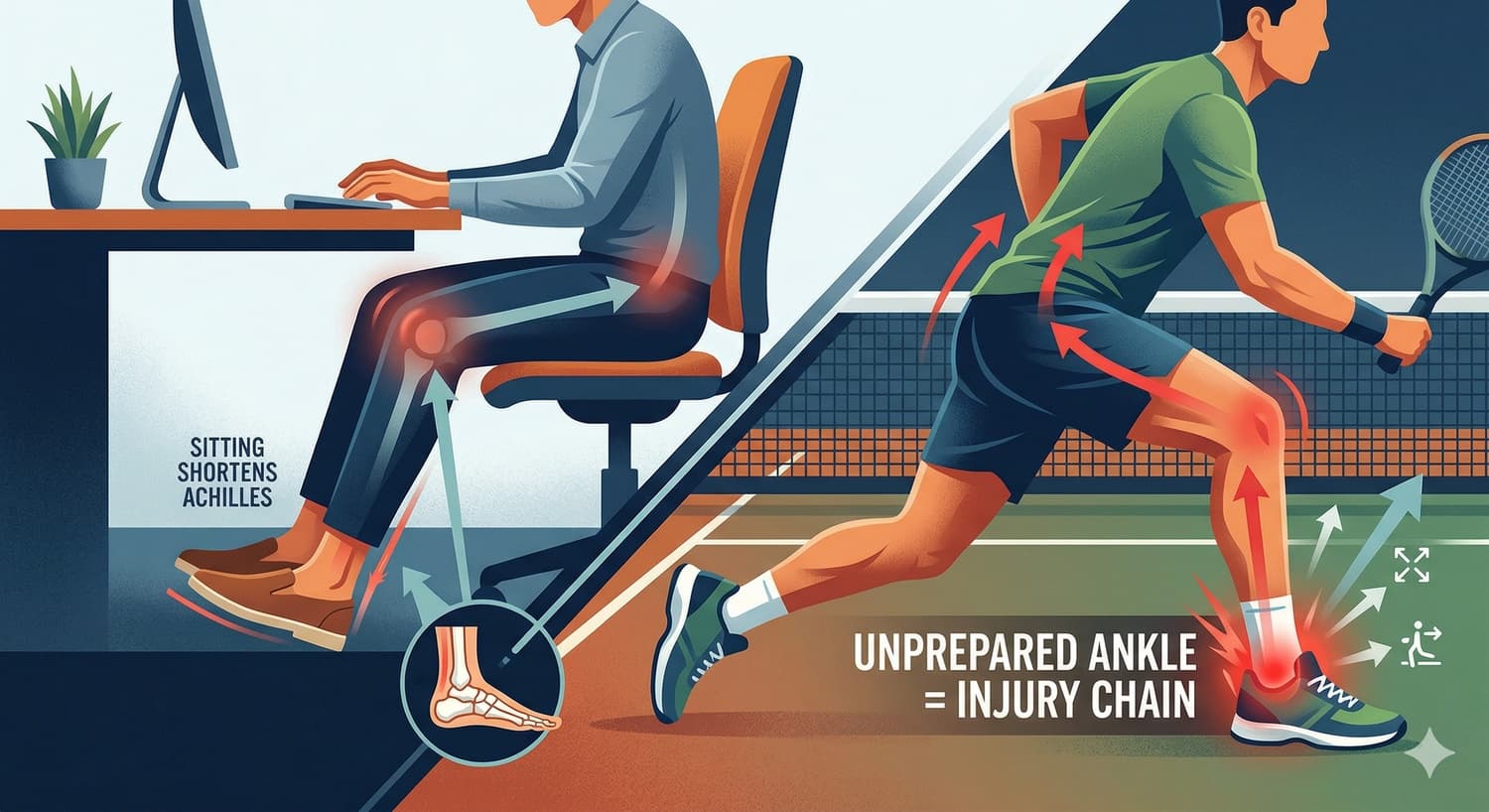
The Most Ignored Joint in Recreational Sport
The ankle is the most commonly injured joint in recreational sport. It is also the least trained.
That's not a coincidence — it's a gap in how recreational athletes prepare. Shoulders get stretched. Knees get iced. Ankles get ignored until they fail. And when they fail, most athletes rest for a week and return to play before the joint has actually recovered — setting up the next injury.
Here's what nobody tells you: ankle instability doesn't stay local. It changes how your knee loads. It alters your hip mechanics. Over months, it becomes the lower back complaint that appears to have no cause.
The kinetic chain starts at the ground.
Mobility vs. Stability: What You Actually Need
Most athletes either have too little ankle mobility (restricted range of motion) or too little stability (poor neuromuscular control under load). Often both.
- Mobility is your ankle's ability to move through its full range — particularly dorsiflexion (pulling toes toward your shin). Restricted dorsiflexion forces the knee to compensate on every step, squat, and lateral cut.
- Stability is your ankle's ability to control that range under load. This is a neuromuscular skill. You can have full mobility and still roll your ankle if your stability system isn't "awake."
Recreational athletes typically need both. They train neither.
Why "Desk Athletes" Are Especially Vulnerable
Prolonged sitting restricts ankle dorsiflexion. Shoes with heel elevation (standard office wear) shorten the Achilles and further limit range.
The result? An ankle arriving at weekend sport with reduced mobility, deactivated stabilizing musculature, and no neuromuscular warm-up. Then you plant and cut. The ankle never stood a chance.
The Prevention Protocol: 4 Drills, 7 Minutes
Add this to the beginning of your warm-up for two weeks. Your lateral stability will be noticeably different.
1. Banded Ankle Dorsiflexion
Sit on the floor, resistance band around the foot just below the ankle. Pull the foot toward you against band resistance.
- Dose: 3 × 15 each ankle.
- Why: Directly targets the restriction that precedes most ankle and knee injuries.
2. Single-Leg Balance With Perturbation
Stand on one leg. Close your eyes, or have a partner tap your standing leg lightly to create instability.
- Dose: 30 seconds each side.
- Why: Trains the neuromuscular system to prevent "rolls" before they happen.
3. Heel-to-Toe Walks
Walk on your heels for 20 steps, then walk on your toes for 20 steps.
- Dose: 2 lengths each.
- Why: Activates the anterior tibialis and calf complex in controlled isolation.
4. Ankle Alphabet
Seated or standing, trace the entire alphabet with your foot using only the ankle joint.
- Dose: Both feet, once through.
- Why: Trains the ankle through its full rotational range for unpredictable lateral movements.
"Consistency is a design problem, not a willpower problem."
Entropy turns your wearable data into a sport-specific Protocol — including your pre-game prep. The right drills, timed to your session, built for your sport.
Your wearable is already collecting the data. Entropy turns it into today's protocol →