Your Knee Doesn't Hurt Because of Your Knee
April 7, 2026 · 4 min read · Entropy Lifestyle
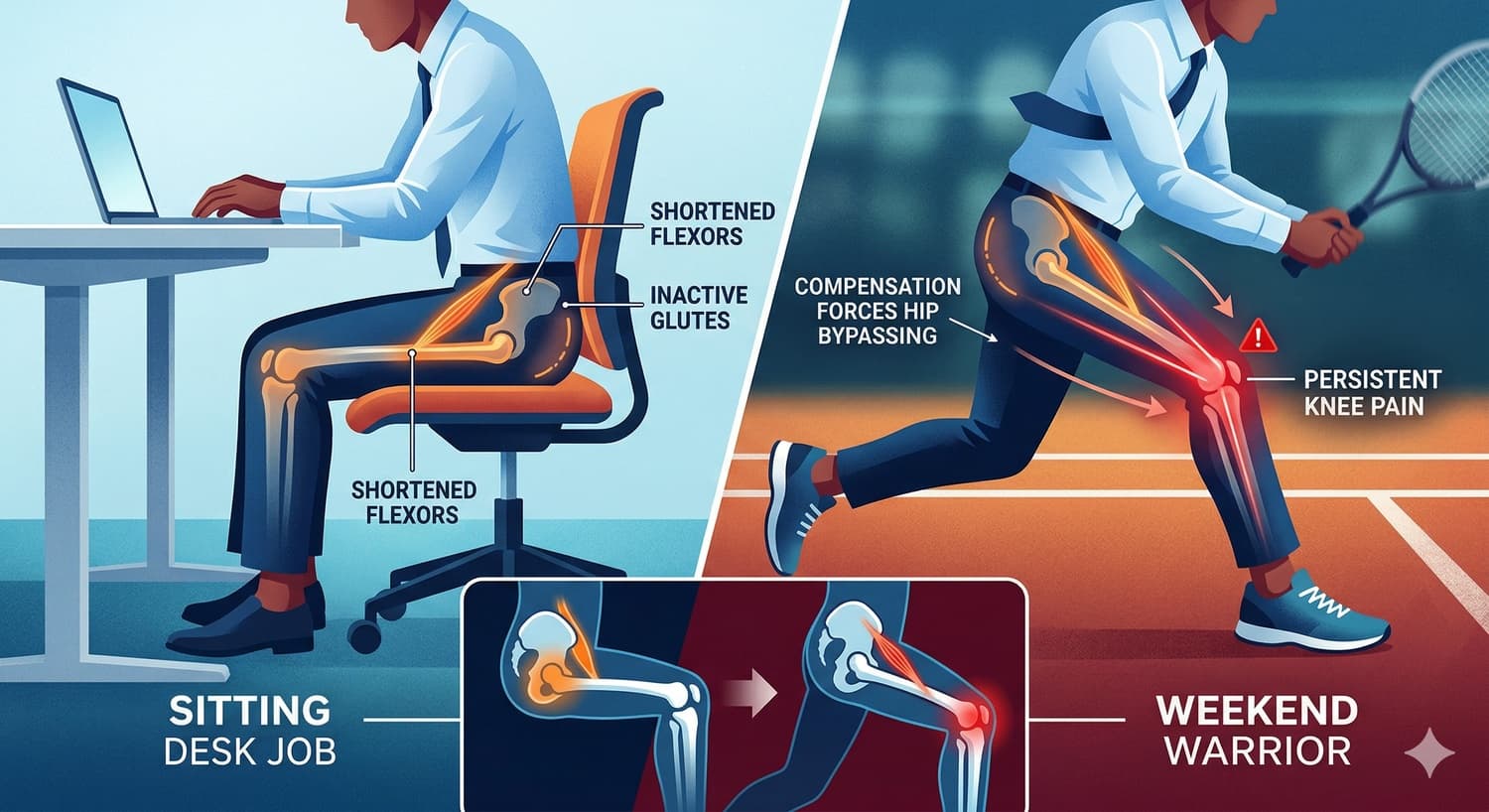
Your Knee Pain is Actually a Hip Problem
If your knee has been bothering you, your physio probably told you to stretch your quad or ice the joint. They might have missed the real problem.
In most recreational athletes, persistent knee pain originates at the hip. Tight hip flexors and inactive glutes — both direct products of desk-job posture — alter the mechanics of every step, every lateral cut, every serve, and every stride.
The knee absorbs the compensation. You're treating the symptom; the cause is two joints up.
What Happens to Your Hips at a Desk
Eight hours of sitting does three things to your hips:
- Shortens the Hip Flexors: Psoas and iliacus remain in a shortened position all day. Over time, they lose their ability to fully lengthen. This tilts your pelvis forward (anterior pelvic tilt), which changes your entire movement pattern during sport.
- Shuts Down the Glutes: When your hip flexors are chronically shortened, your glutes are chronically lengthened — and stop firing efficiently. Weak glute activation is directly linked to patellar tracking problems, IT band syndrome, and ACL injury risk.
- Compresses the Hip Joint Capsule: Reduced blood flow and limited range of motion restrict rotation — exactly the movement pattern needed for lateral cuts in pickleball and tennis, and hip drive in running.
The Weekend Warrior Pattern
Monday to Friday, your hips adapt to sitting. Saturday morning, you ask them to produce athletic-level output. The body's response is predictable: it borrows from adjacent joints. * The knee takes rotational forces it shouldn't.
- The lower back loads asymmetrically to compensate for restricted hip extension.
- The ankle compensates for poor hip stability in single-leg movements.
One tight hip is a cascade.
The Prevention Protocol: 3 Mobility Drills Before You Play
Ten minutes every session. The downstream effect on your knee, ankle, and lower back will be noticeable within two weeks.
1. 90/90 Hip Stretch
Sit on the floor with both knees bent at 90°, one leg in front, one to the side. Sit tall.
- Dose: Hold 60 seconds each side.
- Why: Targets external and internal hip rotators simultaneously—the muscles most restricted by desk posture.
2. Hip Flexor Lunge With Reach
Drop to a half-kneeling lunge. Drive your hips forward until you feel a stretch in the front of the rear leg. Add an overhead reach with the same-side arm.
- Dose: 45 seconds each side, 2 sets.
- Why: Directly addresses psoas shortening and thoracic rotation restriction.
3. Banded Hip Distraction
Loop a resistance band around a rack at hip height. Step into it so the band sits in the hip crease. Step back to create traction. Hold a slight squat position.
- Dose: 45 seconds each side.
- Why: Decompresses the hip joint capsule—highly effective before high-intensity lateral play.
"Consistency is a design problem, not a willpower problem."
Entropy builds your sport-specific Protocol from your wearable data — so the right prep routine shows up before every session, not just when you remember.
Your wearable is already collecting the data. Entropy turns it into today's protocol →