How to Use WHOOP for Sport-Specific Training (Not Just Sleep Scores)
April 15, 2026 · 6 min read · Entropy Lifestyle
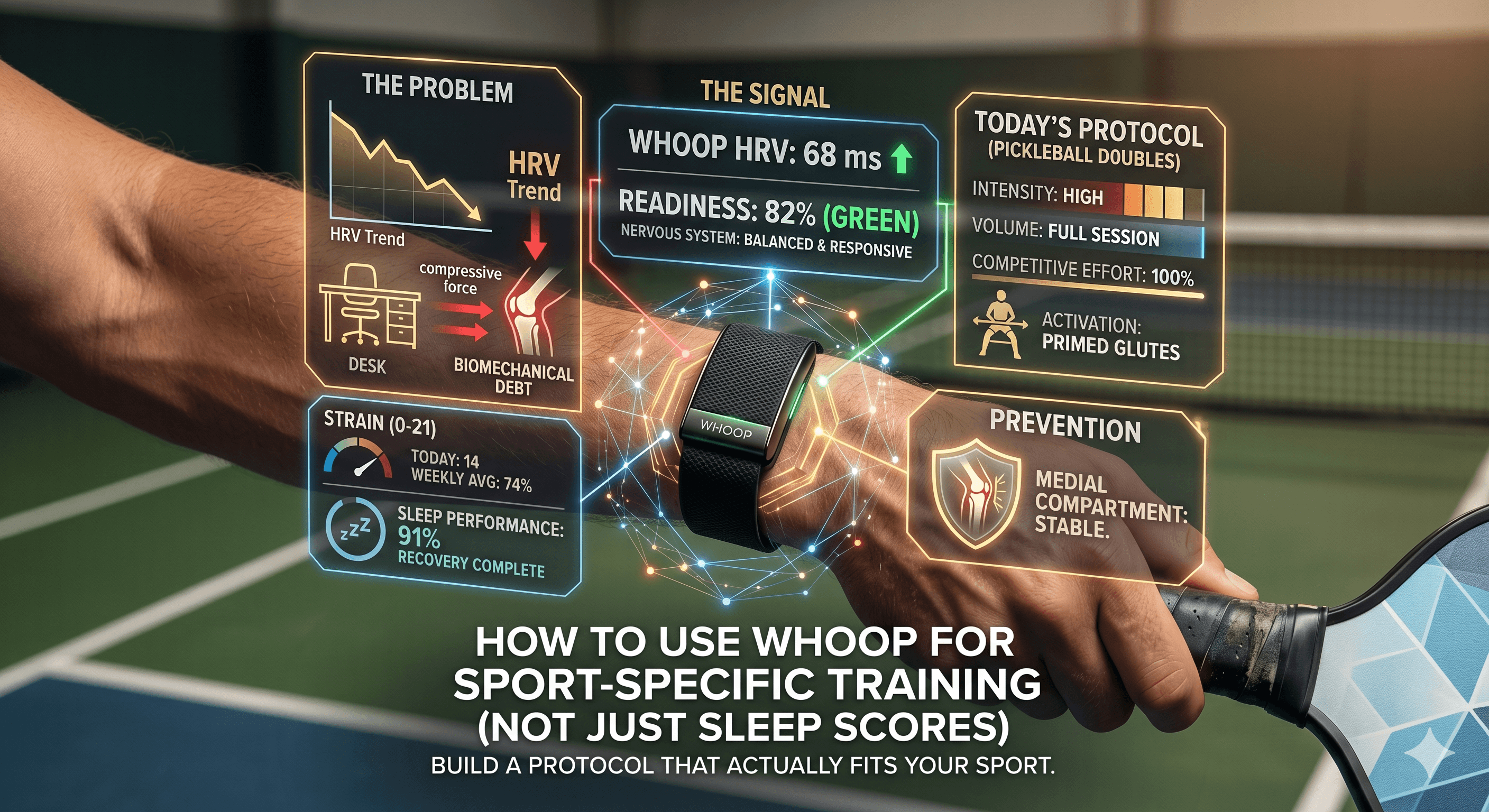
How to Use WHOOP for Sport-Specific Training (Not Just Sleep Scores)
You glance at your WHOOP every morning, see a green recovery score, and think — great, I'm good to go. Or red, and you feel guilty about the match you're already committed to playing.
That's not a protocol. That's horoscope reading with a $30 monthly subscription.
The short answer: WHOOP generates three metrics that matter — HRV (heart rate variability), strain, and sleep performance. Used correctly, these three numbers tell you whether to push today, how hard to play, and what recovery work your body actually needs before you step on the court or hit the trail. The problem isn't the data. It's that nobody has told you how to act on it for your specific sport.
The Problem
Most recreational athletes use WHOOP the same way: check the recovery score, feel validated or vaguely anxious, then do whatever they were already planning to do.
The device is collecting detailed biometric data — HRV trends over 30 days, respiratory rate, skin temperature, sleep staging — and you're using it as a traffic light.
Here's what's actually happening in a typical week: Monday through Friday you sit at a desk for 8–10 hours. Your strain scores are low. Your sleep is mediocre at best. Your HRV drifts down mid-week as accumulated stress loads the autonomic nervous system. Then Saturday arrives and you play 2.5 hours of competitive pickleball or a long trail run. Your strain spikes to 18 or 19. Your Sunday recovery score tanks.
The mismatch between weekday sedentary load and weekend athletic output is the injury formula. And your WHOOP is recording all of it — the warning signs included — while you wonder why your knee keeps flaring up.
The Mechanism
HRV is the core signal. It measures the variation in time between heartbeats — high variability means your autonomic nervous system is balanced and your body is ready to absorb load. Low variability means the opposite: your sympathetic nervous system is running the show, recovery is incomplete, and forcing intensity will deliver diminishing returns at best, a soft tissue injury at worst.
A resting HRV below 45ms — or more specifically, a day where your HRV drops more than 10–15% below your personal baseline — signals that your nervous system hasn't recovered. For a recreational athlete carrying desk job stress and a compressed weekend training window, that signal appears more often than they'd expect.
Strain is the second variable. WHOOP measures cardiovascular strain on a 0–21 scale. A recreational athlete playing competitive doubles pickleball for two hours typically generates a strain of 14–17. Two sessions back-to-back, with a cumulative weekly strain that outpaces recovery capacity, is the physical equivalent of drawing down a bank account without checking the balance.
Your WHOOP has been checking the balance the whole time. You just haven't been reading the statement.
The Protocol
This is how to use WHOOP as an actual training tool — not a data collector you glance at and ignore.
Step 1 — Set Your Baseline Window (Week 1)
Before you adjust anything, wear WHOOP for 7 days without changing your behavior. Let it establish your personal HRV baseline, sleep performance average, and typical strain range. WHOOP calculates a rolling 30-day average — you need at least 7 days of honest data before the recovery scores are meaningful to you specifically. Don't skip sleep tracking. Don't take the band off. Garbage in, garbage out.
Step 2 — Build a Three-Zone Decision Matrix
Map your recovery score to a concrete action, not a vibe.
- Green (67–100%): Full sport session, high intensity, competition-level effort. This is your window to push.
- Yellow (34–66%): Modified session. Play your sport, but cap intensity. In tennis or pickleball, that means drilling over drilling over match play. In running, aerobic pace only — no intervals.
- Red (0–33%): Mobility and activation only. This is not a rest day as a punishment. This is the day your prehab protocol earns its keep. 20 minutes of targeted mobility work protects the sessions that follow.
Step 3 — Cross-Reference Strain With Sport Sessions
Before every sport session, check your weekly strain total, not just today's recovery score. WHOOP shows this in the app. If your weekly strain is already above 70–75% of your typical weekly capacity and it's only Saturday, you don't play 2.5 hours. You play 45 minutes and you leave. The injury doesn't happen on the day you're sore. It happens the day you push a depleted system.
Step 4 — Use Sleep Performance, Not Just Duration
WHOOP distinguishes sleep duration from sleep performance. You can sleep 7 hours and score 58% if your slow-wave and REM staging is disrupted. For the desk-to-sport athlete, alcohol, late meals, and elevated nighttime heart rate (all common Thursday and Friday patterns) tank sleep performance right before the weekend training window. If your sleep performance is below 70% heading into a Saturday match, that's relevant data. Adjust your warm-up, extend your preparation window, and don't expect peak output.
Step 5 — Log Your Sport Sessions as Activities
WHOOP's strain calculation is meaningless if the device doesn't know what you were doing. Manually log your pickleball match, tennis session, or run as an activity. This ties your strain data to specific sport contexts, which makes your 30-day trends actually readable. Over time you'll see exactly how much your body charges for two hours of competitive doubles — and whether you're scheduling adequate recovery before the next session.
The Entropy Angle
WHOOP gives you the data. The problem is that data without a decision framework is just noise with a nice interface. Entropy's Protocol pillar translates your daily WHOOP readiness into specific directives — what to do today, how hard to go, and what preparation your body needs before your sport session. It's not a generic training plan. It's a system built around your wearable data, your sport, and your real schedule.
Prevention isn't extra work. It's already built into your daily protocol →
Key Takeaways
- An HRV drop of 10–15% below your personal baseline is a reliable signal to reduce session intensity — not skip it entirely, but modify it.
- Strain scores are only useful when tracked cumulatively across the week, not read in isolation each morning.
- Sleep performance below 70% before a sport day means extending your preparation window and lowering output expectations.
- WHOOP data without a decision framework is information, not a protocol — the system around it is what changes your injury rate.
Frequently Asked Questions
How do I use WHOOP for training as a recreational athlete?
Start by establishing your personal HRV baseline over 7 days, then build a three-zone decision matrix: green recovery means full sport session, yellow means modified intensity, red means mobility and prehab only. Cross-reference daily recovery with your weekly strain total before committing to session intensity. The goal is matching load to capacity, not chasing green scores.
What does WHOOP HRV actually tell you about your readiness to train?
HRV measures heart rate variability — the time gap between beats. Higher variability indicates a balanced autonomic nervous system and good recovery. When your HRV drops more than 10–15% below your 30-day baseline, your nervous system is under stress and your capacity to absorb training load is reduced. It's not a reason to stop training; it's a signal to adjust intensity.
How long before WHOOP data becomes useful for training decisions?
You need a minimum of 7 days of consistent data for WHOOP's recovery scores to reflect your personal baseline. The 30-day rolling average becomes meaningfully accurate around day 14–21. Most athletes see clear patterns in their HRV — mid-week dips, weekend strain spikes — within the first month of honest, consistent tracking.
Can I still play my sport on a red recovery day?
A red recovery day doesn't automatically mean no sport. It means no high-intensity sport. If you have a scheduled match, shorten the session, play at a controlled intensity, extend your warm-up to 15–20 minutes, and prioritize movement quality over competitive output. Pushing a true red day — especially if HRV is more than 20% below baseline — is where overuse injuries compound quietly.
Why does my WHOOP recovery tank every Sunday even when I sleep well?
Saturday strain is the most common culprit. Two hours of competitive pickleball or a long run generates a strain of 14–18 on WHOOP's scale. If your body hasn't had adequate recovery time or your HRV was already trending down mid-week, the Saturday load isn't fully processed by Sunday morning. This is the desk-to-sport athlete pattern — low weekday activity followed by a high weekend spike — and it's exactly the cycle a sport-specific protocol is designed to manage.
Your wearable is already collecting the data. Entropy turns it into today's protocol →