The Desk Job + Weekend Sport Equation Your Spine Hates
April 5, 2026 · 4 min read · Entropy Lifestyle
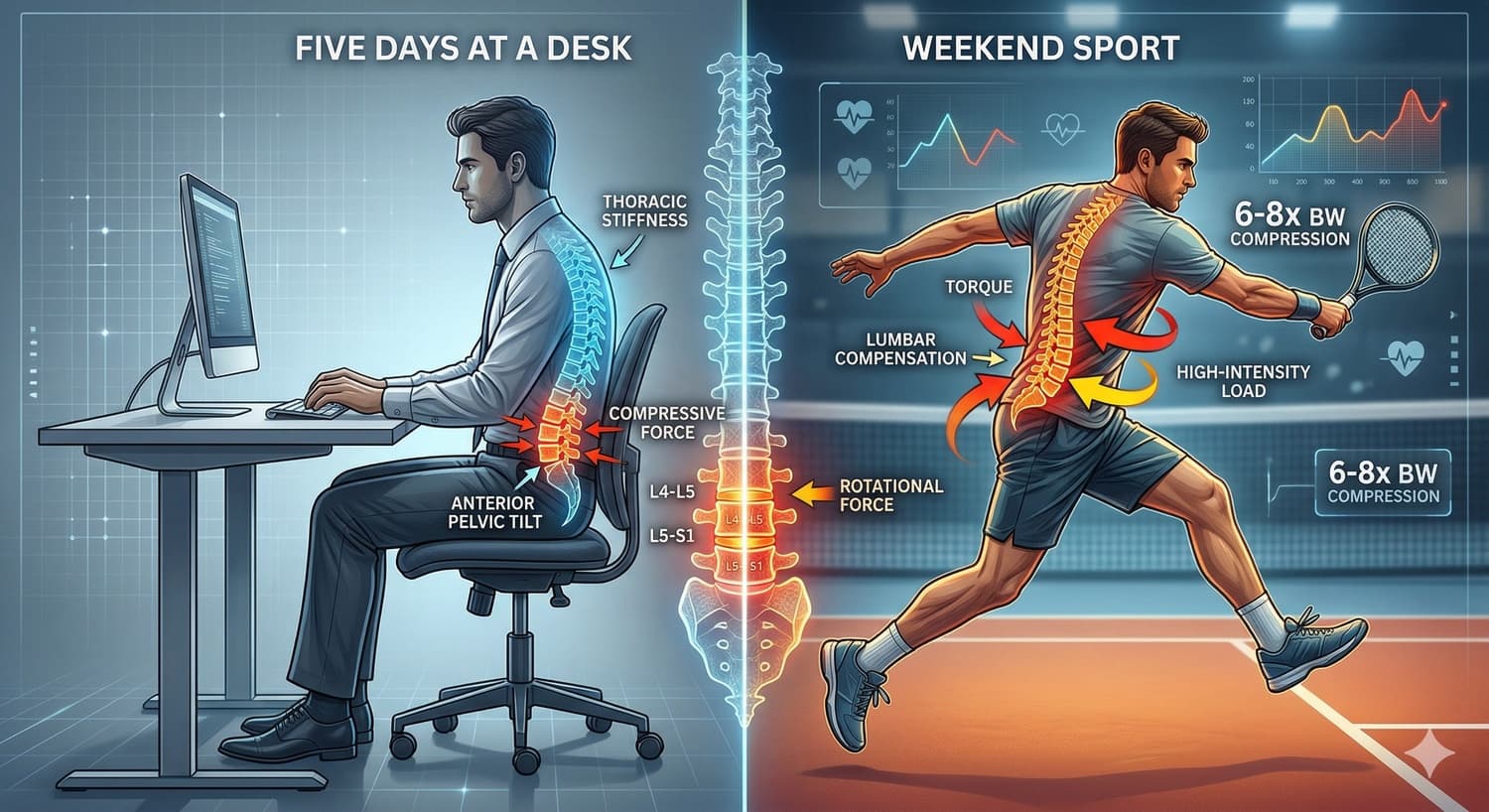
Your Spine Wasn't in the Planning Meeting
You sit for 45 hours a week. On the weekend, you sprint, rotate, decelerate, and compete.
Your spine was not part of the planning meeting.
Lower back pain is the most reported complaint among recreational athletes over 35 — and it's almost entirely predictable. Not because sport is dangerous, but because the transition from desk posture to athletic load is almost never managed deliberately.
What Five Days at a Desk Does to Your Spine
Prolonged sitting does three things that directly increase lower back injury risk in weekend sport:
- Anterior Pelvic Tilt: Shortened hip flexors pull the pelvis forward, exaggerating the lumbar curve. In this position, the lumbar spine is under continuous compression — even before you add sport load.
- Thoracic Stiffness: The mid-back loses its ability to rotate freely. When rotation is required — in a tennis serve, a pickleball backhand, or a running stride — the lumbar spine compensates, absorbing rotational forces it's not designed for.
- Core Deactivation: Sitting reduces the demand on the deep stabilizing muscles of the spine (multifidus, transverse abdominis). In sport, when dynamic stability is needed, they're not firing at full capacity.
This is the desk-to-sport gap in its most mechanical form.
The Lumbar Load Reality
Your lumbar spine absorbs compressive force equivalent to 6–8 times your bodyweight during high-intensity sport movements. For a 75kg recreational athlete, that's 450–600kg per rep.
With a deactivated core, anteriorly tilted pelvis, and stiff thoracic spine, much of that force concentrates at the L4-L5 and L5-S1 discs — the two most commonly injured levels in recreational athletes.
This is not about being unfit. This is about the mechanics of desk posture meeting sport load without a buffer.
The Protocol: Post-Game Spine Reset
After every session. Ten minutes. This is your lumbar decompression sequence.
| Exercise | Dose | Why it Works |
|---|---|---|
| Child's Pose w/ Lateral Reach | 60s each side | Decompresses the lumbar spine; addresses lateral shortening. |
| Cat-Cow | 10 slow reps | Restores segmental spinal movement; reduces post-game stiffness. |
| Dead Bug | 3 × 8 each side | Reactivates deep core stabilizers without loading the lumbar spine. |
| 90/90 Hip Stretch | 60s each side | Releases hip flexor tension that directly loads the lower back. |
| Thoracic Rotation | 10 reps each way | Restores the rotation your lumbar spine compensated for during play. |
"Consistency is a design problem, not a willpower problem."
The session-end routine is the most skipped part of any recreational athlete's week. Entropy makes sure it's not. Your Protocol — built from your wearable data, timed to your actual sessions.
Your wearable is already collecting the data. Entropy turns it into today's protocol →