The Desk-to-Court Problem Nobody Talks About
April 15, 2026 · 8 min read · Entropy Lifestyle
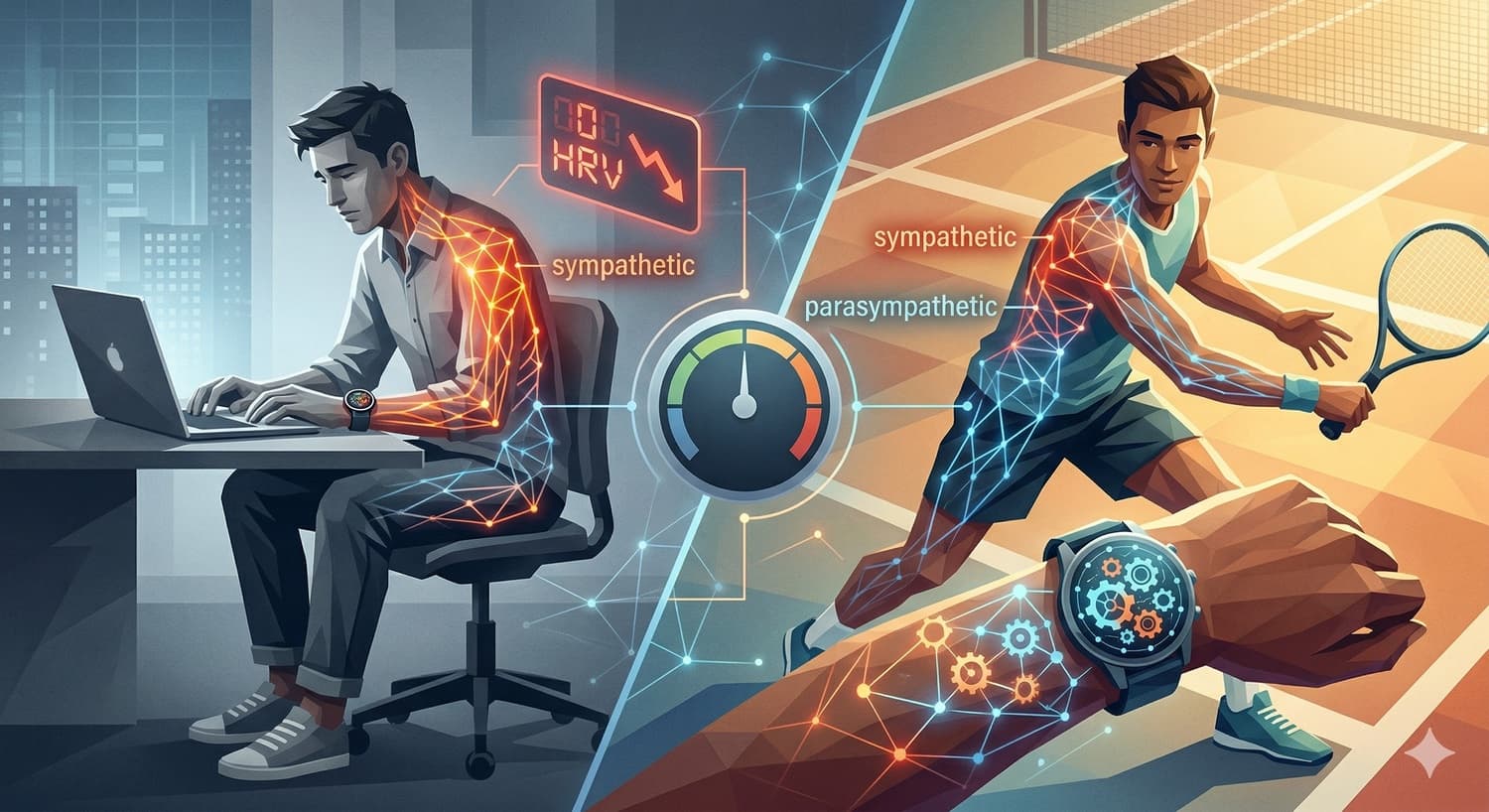
The Desk-to-Court Problem Nobody Talks About
You didn't blow your calf because you pushed too hard in the third set. You blew it because your body had been sitting in a chair for 40 hours and nobody warned you what that does to tissue.
The short answer: Recreational athletes get injured on weekends because five days of desk work systematically shortens hip flexors, suppresses neuromuscular firing patterns, and reduces tissue tolerance — then a single high-intensity session demands the full range, speed, and load the body can no longer safely provide. The mismatch between sedentary weekday load and weekend sport load is the injury, not the sport itself. Wearable data — specifically HRV trends and resting heart rate drift — can flag when that gap is widest before you step on the court.
The Problem
Picture the week in load terms.
Monday through Friday: you sit. Eight to ten hours a day, hips at 90 degrees, thoracic spine in flexion, glutes neurologically quiet, hip flexors in a shortened position long enough that they start to treat that length as neutral. Your step count might hit 3,000 on a good day. Your tissue isn't recovering from anything — it's just existing. Compressed and underused.
Then Saturday arrives.
You show up to the court or the trail carrying the biomechanical debt of five consecutive sedentary days. You do a cursory warm-up — maybe a light jog, maybe nothing — and within twenty minutes you're changing direction hard, loading a single leg, accelerating and decelerating at speeds your neuromuscular system hasn't practised all week.
The hip flexors are tight. The glutes aren't firing at full capacity because they haven't needed to. The posterior chain — the hamstrings, glutes, and lower back — is essentially cold-starting after a week of disuse. Ankle dorsiflexion is restricted from hours in a static foot position. And if your sleep was disrupted mid-week, your tendons are measurably less tolerant to load: research shows tendon stiffness decreases with sleep debt, reducing their capacity to absorb and return force safely.
This isn't bad luck. It's a predictable physiological outcome of a predictable lifestyle pattern. The injury happens on Saturday, but it was scheduled on Tuesday.
The Mechanism
The specific failure point is the neuromuscular lag between tissue demand and tissue readiness.
When you sit for extended periods, the hip flexors — primarily the iliopsoas and rectus femoris — adaptively shorten. Simultaneously, the opposing glutes enter a state called arthrogenic inhibition: the nervous system reduces their motor unit recruitment because the joint position signals that full activation isn't needed. You're not losing strength in any permanent sense. You're losing access to it.
When you then ask those same muscles to perform explosive, multi-planar movements — a wide lateral lunge in pickleball, a hard uphill push in a trail run, a split-step into a forehand — the motor pattern fires, but the glutes contribute less than they should. The load gets distributed to structures less suited to carry it: the knee joint absorbs more valgus stress, the lumbar spine compensates for reduced hip extension, the Achilles takes more tensile force than the calf can buffer.
Your wearable is often reading this story before you feel it. A WHOOP or Garmin that shows HRV suppression mid-week — below your 7-day baseline by more than 10% — combined with elevated resting heart rate isn't just showing poor recovery from the previous weekend. It's showing an autonomic nervous system under load. That same suppressed state correlates with reduced proprioceptive accuracy: your joint position sense degrades when your nervous system is stressed, which means your body is less precise about where your limbs are in space during fast movement. Less precision at high speed is how ankles roll and knees collapse.
The desk-to-court problem is a load management problem, a neuromuscular problem, and a data-reading problem simultaneously.
The Protocol
This isn't about adding two hours of stretching to your weekend. It's about strategic interventions at specific points during the week that keep the gap between desk-state and sport-state from becoming an injury gap.
Monday and Wednesday — 10-Minute Desk Reset
Mid-afternoon, before you've fully stiffened: 90/90 hip flexor stretch, 90 seconds each side with active posterior pelvic tilt (not passive hanging). Follow with 10 slow, controlled single-leg glute bridges on each side — pause 2 seconds at the top, focus on full glute contraction before lowering. This isn't a workout. It's neuromuscular maintenance. You're reminding the motor pathways what full hip extension feels like.
Friday Night — Pre-Load Check
Open your wearable app before you go to bed. Check your HRV against your 7-day average. If you're down more than 10–15% and your resting heart rate is elevated by 3–5 BPM, that's a signal. It doesn't mean don't play Saturday. It means play at 75%, skip the third set, and extend your warm-up by 10 minutes. The data is giving you a dial to turn, not a stop sign.
Saturday Morning — Activation Before Recreation
Twelve minutes before you play, not as you arrive: leg swings (forward and lateral, 15 each side), banded clamshells (20 reps each side with a light band), and 5 lateral shuffle sequences at 60% speed. This is not warm-up cardio. This is glute activation and hip mobility priming. You're overriding the sedentary default your body spent five days installing. Without this, the first 20 minutes of your session are your warm-up — and that's exactly when most recreational athlete injuries happen.
Post-Session — The 30-Minute Window
Within 30 minutes of finishing: 400–500mg of sodium with fluid (sweat loss drives cramping and next-day soreness more than most people realise), and 5 minutes of supine 90/90 breathing — knees bent, feet flat, slow exhale through the mouth to drive parasympathetic recovery. Not optional if you want Sunday to feel like a human being.
Track the Pattern, Not Just the Sessions
Log your readiness score and your session intensity together — not just your weekend sessions, but your Tuesday and Thursday desk days. The athletes who stop getting injured are the ones who stop treating weekdays as blank space between weekend sport. They're not blank. They're accumulating.
The Entropy Angle
The desk-to-court problem doesn't get solved by knowing about it. It gets solved by having a system that accounts for it automatically — one that reads your wearable data across the whole week, not just post-session, and adjusts your daily directives based on how much sedentary load you've accumulated versus how much sport load you're planning. That's what Entropy is built to do: take the mismatch out of your hands so you stop arriving at Saturday depleted, stiff, and one wrong step from a month on the sideline.
Prevention isn't extra work. It's already built into your daily protocol →
Key Takeaways
- Five days of desk work systematically reduces glute activation and hip flexibility, creating a biomechanical gap that weekend sport reliably exposes.
- The primary injury mechanism is neuromuscular lag — your motor patterns fire, but inhibited glutes redistribute load to less tolerant structures like the knee and Achilles.
- HRV suppression and elevated resting heart rate mid-week are wearable signals that predict elevated injury risk on the weekend, not just poor recovery from the last session.
- Twelve minutes of activation before Saturday play — not at the venue, before you leave — is the single highest-leverage intervention for breaking the desk-to-court injury cycle.
Frequently Asked Questions
Why do I keep getting injured on weekends even though I play every week?
Playing every weekend doesn't eliminate the desk-to-court problem — it just means you're repeatedly exposing a body that re-enters a sedentary state Monday through Friday. Consistent weekend sport without mid-week movement maintenance keeps resetting the neuromuscular deficit. The solution isn't more weekend volume; it's brief, targeted interventions during the week.
What actually causes weekend warrior injuries?
The root cause is the mismatch between sedentary weekday load and high-intensity weekend sport load. Specifically: prolonged sitting shortens hip flexors and inhibits glute activation, and when you then demand explosive multi-planar movement, the motor system distributes that load to structures — knees, Achilles, lumbar spine — that aren't positioned to handle it safely.
How long does it take to fix the desk-to-court problem?
Most recreational athletes notice a meaningful reduction in next-day soreness and minor injury frequency within 3–4 weeks of consistent mid-week activation and pre-session priming. The neuromuscular patterns respond quickly once you start re-activating them. The harder habit to build is the consistency — which is why a protocol system outperforms individual motivation every time.
Can I still play my sport hard while working on this?
Yes — with one adjustment. Check your wearable readiness data before Saturday. If HRV is suppressed by more than 10–15% below your baseline, reduce intensity to around 75% and extend your warm-up. Playing at full intensity on an already-stressed nervous system is where serious injuries happen. Playing smart while you build the protocol is how you stay in the game.
How does wearable data help prevent weekend sport injuries?
Your HRV trend across the week reflects cumulative autonomic stress — from poor sleep, work stress, and sedentary load, not just exercise. A suppressed mid-week HRV correlates with reduced proprioceptive accuracy and lower tissue tolerance, both of which increase injury risk during fast sport movement. Tracking your full-week readiness, not just post-session recovery, gives you a usable injury risk signal before Saturday arrives.
Your wearable is already collecting the data. Entropy turns it into today's protocol →