What a Low HRV Day Is Actually Telling You
April 13, 2026 · 6 min read · Entropy Lifestyle
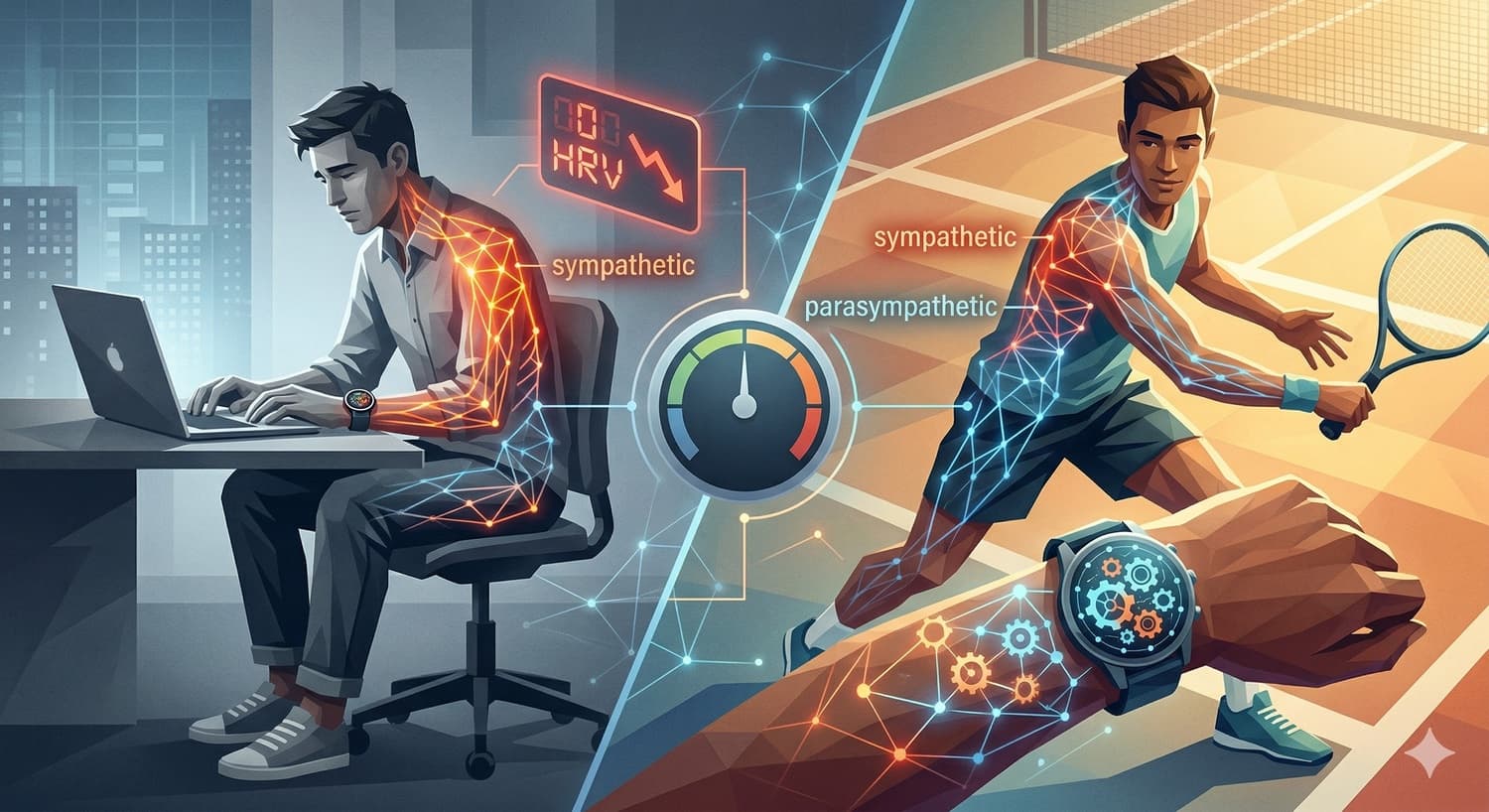
What a Low HRV Day Is Actually Telling You
You woke up, checked your wearable, and the number is down. Now you don't know whether to push through or pull back — so you guess.
That guess is costing you more than you think.
The short answer: A low HRV reading means your autonomic nervous system is under load — your body is spending recovery resources it hasn't finished allocating yet. It is not telling you to do nothing. It is telling you to adjust intensity, protect adaptation, and not add a stressor your system can't absorb. Athletes who learn to read this signal and modify their day accordingly get more quality sessions per month than athletes who ignore it.
The Problem
Heart rate variability is one data point, but it's the most honest one your wearable produces. While resting heart rate and sleep score give you ballpark signals, HRV measures the millisecond variation between heartbeats — a direct window into how well your autonomic nervous system is balancing sympathetic and parasympathetic activity. When HRV drops below your personal baseline by 10–15%, something in the system is stressed.
Here's where it breaks down for the desk-to-sport athlete: you had a hard pickleball session Saturday. Sunday your HRV is suppressed. You rest Sunday, feel okay Monday, so you push hard again Tuesday morning before work. What you don't see is that Tuesday's HRV is still 18% below your rolling 7-day average — your body hasn't finished the repair job. You added load on top of incomplete recovery.
That pattern — stacking sessions before adaptation is complete — is how soft tissue injuries develop. Not from one explosive move, but from chronic, low-grade under-recovery that degrades tissue quality over weeks until something finally gives. Your wearable saw it coming. You just didn't know what it was saying.
The Mechanism
HRV is governed by your autonomic nervous system. High parasympathetic tone — the "rest and digest" state — produces high beat-to-beat variability. High sympathetic tone — the "fight or flight" state — irons out that variability. When HRV drops, it means sympathetic dominance is elevated.
That elevation can come from a hard training session, poor sleep, psychological stress, alcohol, illness, heat, or caloric deficit. Critically, the nervous system doesn't distinguish between training stress and life stress — it registers all of it as load. A brutal week at work shows up in your HRV exactly the same way a hard interval session does.
When you train hard while sympathetic tone is already elevated, you're asking your body to generate a training adaptation it doesn't have the hormonal or neurological resources to complete. Cortisol stays high, testosterone suppression extends, muscle protein synthesis stalls. The session wasn't wasted — it was counter-productive. The signal was there at 6am. You just didn't have a protocol for it.
The Protocol
A low HRV day is not a rest day by default. It's a modified day. Here's how to calibrate it.
Step 1 — Define your threshold before the day starts Set a personal HRV floor using your rolling 7-day average (most wearables calculate this automatically). A drop of 10% or more below that average = modified day. A drop of 20% or more = full recovery protocol. Without a defined threshold, every low reading becomes a judgment call you'll make wrong when you're tired.
Step 2 — If you're playing or training, drop intensity, not volume Zone 2 cardio, technical drills at low pace, or a skills-only court session are all viable. What you're avoiding is maximal effort, explosive deceleration, and heavy load — the inputs that require your nervous system to be fully resourced. A 45-minute Zone 2 run when HRV is suppressed does less damage and still maintains the habit.
Step 3 — Run a 10-minute morning nervous system reset before any activity Box breathing (4 counts in, 4 hold, 4 out, 4 hold) for 5 minutes activates parasympathetic tone measurably. Follow it with slow, controlled movement — a 90/90 hip flexor stretch held 90 seconds per side and a cat-cow sequence for 2 minutes. You are not warming up for a session. You are downregulating a system that woke up in the red.
Step 4 — Track what drove the drop After a few weeks of logging HRV alongside sleep, alcohol intake, training load, and stress level, patterns emerge. Most athletes discover their HRV tanks reliably after two consecutive high-output days, after fewer than 6.5 hours of sleep, or after drinking even one drink the night before. Once you know your personal triggers, you can anticipate low HRV days — not just react to them.
Step 5 — Prioritize nutrition and sleep on low HRV days, not supplements Carbohydrate intake supports glycogen replenishment and cortisol modulation. Protein synthesis continues overnight. Aiming for 7–9 hours of sleep on the night following a low HRV reading is the single highest-leverage intervention available. No recovery product comes close.
The Entropy Angle
A low HRV reading is only useful if you have a protocol to respond to it. Most athletes get the data — the wearable delivers it every morning — and then spend 30 seconds wondering what it means before getting on with their day unchanged. Entropy reads that signal and turns it into today's directive: specific intensity targets, movement prep, and recovery actions matched to your actual readiness. The data already exists. The protocol is what's missing.
Prevention isn't extra work. It's already built into your daily protocol →
Key Takeaways
- A low HRV reading signals autonomic nervous system stress — your body is under load it hasn't finished processing yet.
- The correct response is intensity modification, not automatic rest — Zone 2 sessions and technical work are still on the table.
- Life stress and training stress register identically in HRV; your wearable doesn't care what caused the drop.
- Consistent HRV logging over 3–4 weeks reveals your personal triggers, turning reactive adjustments into predictive protocol.
Frequently Asked Questions
What should I do on a low HRV day?
Modify intensity rather than cancelling activity entirely. Drop explosive, high-load, or high-effort sessions and substitute Zone 2 cardio, technical drills, or mobility work. Use a 10-minute parasympathetic reset in the morning — box breathing followed by slow controlled movement — and prioritise sleep that night above all else.
What causes HRV to drop overnight?
HRV drops when sympathetic nervous system tone is elevated — meaning your body is managing stress of some kind. Common causes include hard training sessions, fewer than 7 hours of sleep, alcohol consumption, psychological stress, heat, illness, or caloric deficit. The nervous system treats all of these as load, so a stressful work week can produce the same HRV suppression as a two-hour workout.
How long does it take for HRV to recover after a hard session?
For most recreational athletes, HRV returns to baseline within 24–48 hours after a moderate session. After a very hard effort — a long race, a 3-set match in heat, or back-to-back high-output days — suppression can persist for 48–72 hours. This is why stacking intense sessions without checking readiness leads to compounding under-recovery.
Can I still play pickleball or tennis on a low HRV day?
Yes, with adjustment. Avoid full-speed, high-intensity match play if your HRV is more than 15% below your rolling average. Drilling, doubles with reduced court movement, or a technical practice session at controlled pace is a better call. The sport-specific risk on a low HRV day is that your reaction time is slower and your neuromuscular control is reduced — the conditions that produce ankle rolls and knee injuries.
How does Entropy use HRV data to build my daily protocol?
Entropy reads your wearable data — WHOOP, Garmin, Apple Watch, or Oura — and generates sport-specific daily directives based on your actual readiness score. On a low HRV day, your protocol automatically reflects modified intensity, targeted recovery actions, and prep work that matches where your body is, not where you wish it was.
Your wearable is already collecting the data. Entropy turns it into today's protocol →