Why Pickleball Players Keep Getting Knee Injuries
April 13, 2026 · 7 min read · Entropy Lifestyle
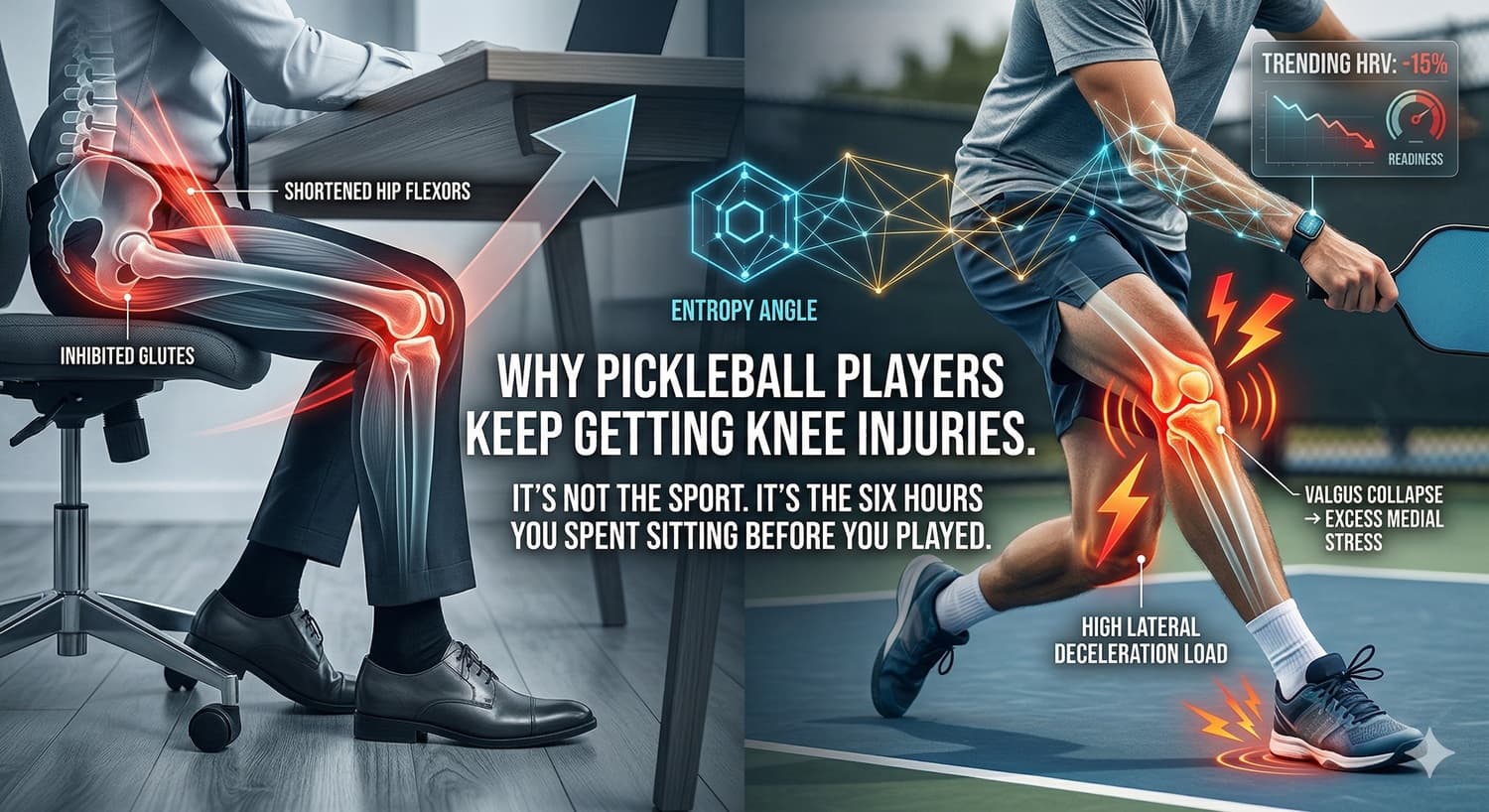
Why Pickleball Players Keep Getting Knee Injuries
Pickleball didn't hurt your knee. The six hours you spent sitting before you played did.
You just didn't feel it until the third game.
The short answer: Pickleball players get knee injuries because the sport demands rapid lateral deceleration — hard stops, direction changes, split-step landings — from a body that has been sedentary all week. When the hip abductors and glutes are disengaged from prolonged sitting, the knee absorbs force it was never designed to handle alone. This valgus collapse under load is the injury formula. It's not the sport. It's the mismatch between how you live Monday through Friday and what you ask your body to do on Saturday morning.
The Problem
Picture the pattern: you play two hours of recreational doubles on a Saturday. You're moving well in the first set. By the second, your footwork gets lazy. You stop planting and start coasting. You take a hard cut to your backhand side and something in your knee fires a warning shot — a sharp twinge, or worse, nothing at all until the next morning when you can't walk downstairs without wincing.
This isn't a pickleball problem. It's a desk-to-court problem.
Pickleball is uniquely punishing because of how often it demands deceleration. A typical recreational game involves roughly 4 to 8 direction changes per point, repeated across dozens of rallies. Every hard stop sends a ground reaction force up through the kinetic chain. Under ideal conditions — hips loaded, glutes firing, core braced — that force gets distributed across the entire lower body. Under real conditions — eight hours of sitting, hip flexors shortened, glutes neurologically inhibited — the knee takes the hit alone.
The medial collateral ligament, the patellar tendon, and the medial meniscus are not built to be the last line of defence. When they are, they fail. Slowly, then suddenly.
The Mechanism
The clinical term is gluteal amnesia, and it is exactly what it sounds like. Prolonged sitting compresses the hip flexors and reciprocally inhibits the glutes — the neurological pathway that tells your posterior chain to fire gets suppressed through sustained non-use. Studies have shown measurable decreases in gluteus medius activation after as little as 30 minutes of seated hip flexion.
When you step on the court without addressing this, your body still moves. It compensates. The knee drifts inward under load — valgus collapse — because the hip abductors aren't generating enough lateral force to keep the joint stacked. That inward drift increases stress on the medial compartment of the knee by as much as 40 percent compared to a properly aligned deceleration. Do that 200 times in a two-hour session and you've accumulated significant mechanical wear on structures that were already under-supported.
Your wearable is often telling you this story before you feel it. A resting HRV that's been trending down across the week, elevated resting heart rate on Saturday morning, or a low readiness score on Garmin or WHOOP — these are signals that your nervous system is already under load before you tie your shoes. Playing hard into a low-readiness day dramatically increases the injury window.
The Protocol
This is a pre-session protocol. It takes 12 minutes. It is not optional.
Glute activation — banded clamshells Place a light resistance band just above the knees. Lie on your side, hips stacked, knees bent at 90 degrees. Open the top knee toward the ceiling while keeping your pelvis still. 20 reps each side. This is not a warmup stretch — it's a neurological wake-up call for the glutes. You are re-establishing the motor pattern your desk killed.
Hip flexor release — 90/90 stretch Sit on the floor with both legs bent at 90 degrees, front and back. Square your hips and tall-sit your spine. Gently drive your front hip toward the floor. Hold 90 seconds each side. Focus on a posterior pelvic tilt — imagine tucking your tailbone slightly under. This counteracts hip flexor shortening and restores the hip extension range you need for proper deceleration mechanics.
Lateral band walks Keep the band above the knees. Stand hip-width apart, slight bend in the knees, hips back. Walk laterally 15 steps each direction, maintaining tension in the band throughout. This primes the hip abductors and gluteus medius — the exact muscles that prevent valgus collapse under lateral load.
Dynamic deceleration drill — 5 minutes Before your first game, do 10 repetitions of controlled lateral shuffle with a hard stop. Focus on landing with your hips behind your knees, not your knees over your toes. Drive your outside hip down and back as you stop. You are rehearsing the pattern at low intensity before the game asks for it at high intensity.
Check your readiness score before you play. If your HRV is more than 10 percent below your 7-day baseline, reduce intensity in the first game. Let the protocol work before you push.
The Entropy Angle
Knowing this protocol exists is not the same as doing it every time you play. That gap — between knowing and doing — is where most recreational athletes get hurt. Entropy closes it. Your wearable data feeds your readiness score, your readiness score shapes your daily directive, and your pre-session protocol is built into the system before you've even found your paddle. Prevention stops being something you have to remember and starts being something that just happens.
Key Takeaways
- Pickleball knee injuries follow a predictable mechanical pattern: gluteal inhibition from sitting leads to valgus collapse under lateral deceleration load.
- A 12-minute pre-session activation protocol — banded clamshells, 90/90 hip flexor stretch, lateral band walks, and deceleration drills — directly addresses the failure point before it becomes an injury.
- Your wearable's readiness score is a real injury-risk signal: playing hard when HRV is significantly below your baseline measurably increases mechanical vulnerability.
- Prevention only works when it's systematic — a one-time protocol means nothing; a protocol built into your daily system means consistent protection.
Frequently Asked Questions
Why do pickleball players get knee injuries so often?
Pickleball demands frequent, high-intensity lateral deceleration — hard stops and direction changes — from athletes who spend most of their week sedentary. This mismatch causes the glutes and hip abductors to be underactive when they're needed most, forcing the knee to absorb forces it can't safely handle alone. The sport isn't unusually dangerous; the desk-to-court lifestyle is.
What causes valgus collapse in pickleball players?
Valgus collapse — the knee caving inward under load — is caused by insufficient hip abductor and gluteus medius activation during deceleration. Prolonged sitting suppresses these muscles neurologically. When a pickleball player cuts or stops hard without these muscles firing correctly, the knee drifts inward and the medial structures absorb disproportionate stress. This is the primary injury mechanism behind medial knee pain and MCL strain in recreational pickleball players.
How long does a knee prehab protocol take to show results?
Consistent execution of a pre-session activation protocol — banded glute work, hip flexor release, and lateral band walks — typically produces noticeable improvements in knee stability and pain reduction within 3 to 4 weeks of regular play. The neurological reactivation of the glutes can happen within a single session, which is why even a 12-minute pre-play protocol reduces immediate injury risk the first time you do it.
Can I keep playing pickleball if my knee is bothering me?
It depends on the nature of the pain. Mild muscular soreness and joint fatigue that resolves within 24 hours is generally manageable with modified intensity and a consistent activation protocol. Sharp pain during lateral movement, swelling, or instability are signals to stop and get assessed. Playing through structural warning signs accelerates damage. Use your wearable's readiness data alongside how the joint feels — both signals matter.
How does wearable data help prevent pickleball knee injuries?
Your HRV, resting heart rate, and readiness score reflect your nervous system's recovery state. When these metrics are significantly below your baseline, your neuromuscular coordination and reaction time are compromised — meaning your body is less capable of executing the controlled deceleration mechanics that protect the knee. A low-readiness day doesn't mean don't play; it means reduce intensity in the first game and let your protocol do its job before you push hard.
Your wearable is already collecting the data. Entropy turns it into today's protocol →
Your wearable is already collecting the data. Entropy turns it into today's protocol →